

Do eyelashes grow back?
The short answer: Yes, in most cases.
Medical fact check: Eyelashes follow a natural growth cycle. If an eyelash falls out, this is usually part of the telogen phase (resting phase). The natural regrowth process usually takes 4 to 8 weeks (Source: PMC Clinical Review). However, in the case of permanent, patchy loss (Madarosis), the medical cause must be clarified.

The shock is big: You remove your makeup and suddenly have three eyelashes on the cotton pad. Or you discover an unsightly gap in the lash line. The fear that the root is "dead" is widespread, but often unfounded.
In this evidence-based guide, we differentiate between harmless hair breakage (cosmetic) and real eyelash loss (madarosis). We show you what role the life cycle plays and how eyelash serums with peptides or prostaglandin analogs can physiologically support the process.
Table of Contents
- 1. The eyelash growth cycle simply explained
- 2. Eyelash loss or eyelash breakage?
- 3. Causes of eyelash loss
- 4. When to see a doctor? (Red Flags)
- 5. What really helps with eyelash loss?
- 6. Frequently Asked Questions (FAQ)
1. The Eyelash Cycle: Biological Basics
Eyelashes do not grow “forever”, but in a completely normal cycle. It is common for a few eyelashes to fall out every day – frequently, approx. 1 to 5 eyelashes per day are described as normal.
The cycle has three phases:
Growth phase (Anagen): The eyelash grows actively (approx. 0.12–0.14 mm per day) and this phase lasts only 1–2 months. That is why eyelashes never get as long as scalp hair.
Transition phase (Catagen): The eyelash slowly “stops” growing – the hair follicle adapts. Duration: approx. 15 days.
Resting phase (Telogen): The eyelash remains in the follicle, falls out later, and makes room for a new one. This phase can last several months (up to approx. 4–9 months). Many eyelashes are in this phase simultaneously (Source: J. Cosmet. Dermatol.).
What this means for you: If you see a small gap, there is often no reason to panic – it is usually just timing in the cycle.
2. Eyelash loss or eyelash breakage? How to spot the difference
Important: Before you reach for serum, mascara, or home remedies, you need to know exactly what is happening – because breakage needs different measures than real loss. Many “gaps” are not caused by a dead root, but by friction, incorrect makeup removal, or styling.
Quick self-check (30 seconds):
- Do you see a “piece of eyelash” on the cotton pad (short/blunt)? → likely breakage.
- Is the eyelash completely missing and the spot looks “bald”? → likely loss.
- Is the lid margin itching/red/flaking? → likely inflammation (please note “Warning Signals” section).
A) Eyelash breakage (Trichorrhexis):
The root is intact, but the hair breaks off in the middle. The eyelashes appear short, uneven, or “blunt”.
Common causes: Rubbing, too much pressure with the eyelash curler, rough makeup removal, dryness, chemical treatments (e.g., lifting).
What you can do now:
- Reduce mechanics (see: Using eyelash curler correctly)
- Care & protection against breakage (Routine tips: Keep eyelashes healthy and strong)
- If you do eyelash lifting: Combine eyelash lifting and eyelash serum
B) Eyelash loss (Madarosis):
The eyelash is missing completely – visible gaps appear on the lid margin.
Common causes: Inflammation (e.g., Blepharitis), autoimmune reactions (Alopecia areata), hormonal issues (e.g., thyroid).
What you can do now:
- Causes Guide: Why are my eyelashes falling out?
- If stress/sleep is an issue: Sleep & stress affect eyelashes
- Support from within: Nutrition for strong eyelashes
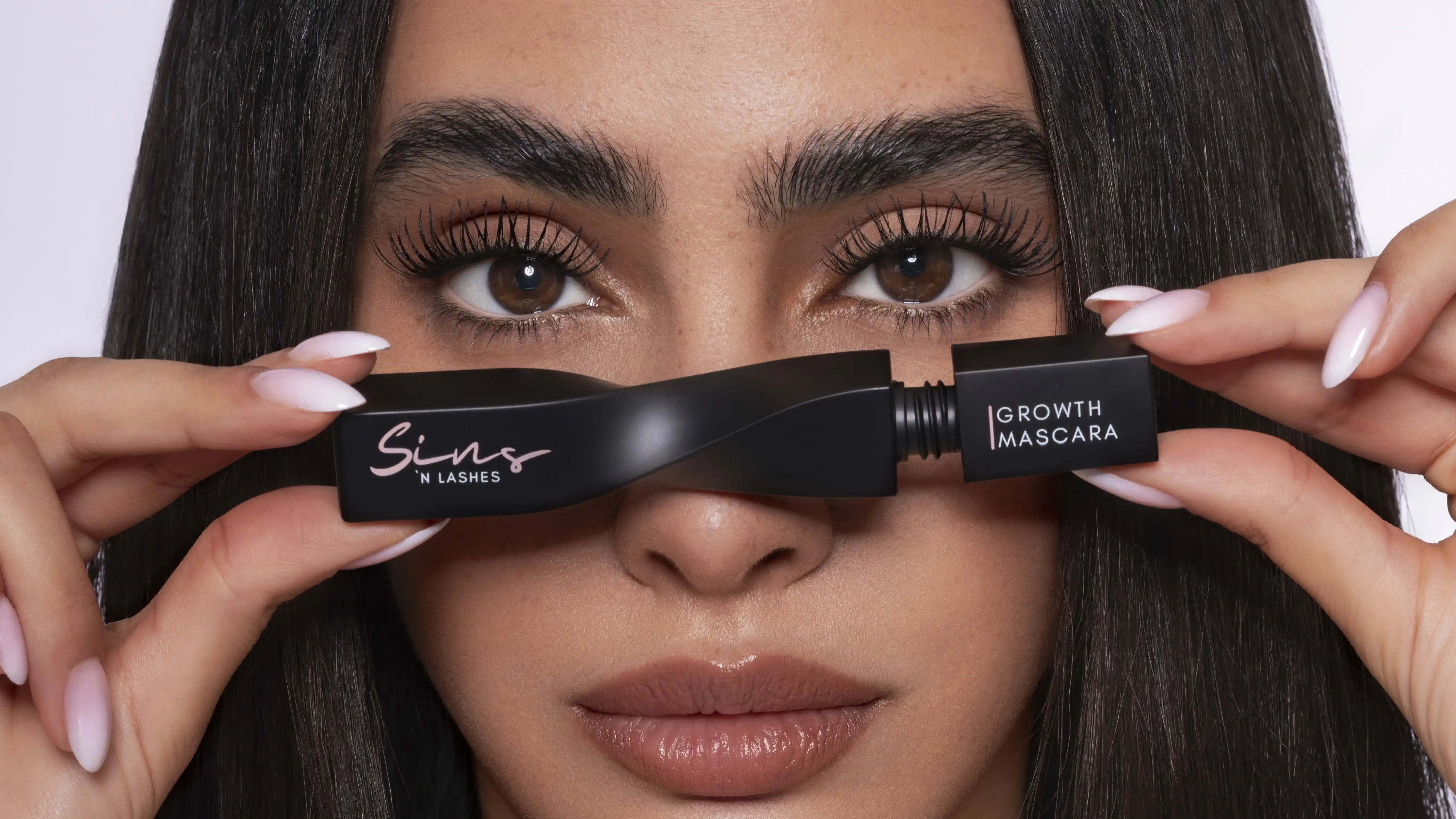
If it is mainly about breakage, dryness, and “short” eyelashes, daily care can help strengthen the eyelash structure – e.g., with a peptide-based eyelash serum. For immediately more definition in the makeup look, a Growth Mascara is suitable as a supplement (optical effect + nourishing routine).
3. Causes of eyelash loss
If eyelashes fall out in patches, there is often more to it than “bad luck with makeup removal”. A medical overview (including PMC review on Madarosis) describes several typical triggers – from lid margin inflammation to hormonal issues. Important: Not everything is dramatic, but some causes should be taken seriously.
Lid margin inflammation (Blepharitis) – one of the most common reasons
Here the lid margin is irritated, often because glands clog or bacteria multiply. This can stress the eyelash roots.
- Typical signs: Redness, itching, burning, scales on the lid margin, “gritty” feeling.
- Why this costs eyelashes: Inflammation + rubbing + weakened roots → eyelashes fall out more easily.
Circular hair loss (Alopecia areata) – can also affect eyelashes
This is an autoimmune reaction in which hair (sometimes also eyelashes and eyebrows) can fall out suddenly.
- Typical signs: suddenly appearing bald spots (also possible on brows/scalp hair).
- Note: This should be clarified by a doctor, especially if it gets worse quickly.
Hormones & Thyroid – when hair generally becomes drier or thinner
With hypothyroidism, hair can generally appear drier, more brittle, and thinner. Case reports also describe that the brows (especially on the outside) can thin out.
- Typical signs: generally more brittle hair, dry skin, noticeable thinning of brows/eyelashes.
- Important: If you suspect this, a check-up with a doctor makes sense.
4) Cosmetic stress – friction, waterproof mascara & extensions
Many eyelashes “don't just fall out”, but are mechanically overloaded over time (tension, rubbing, aggressive makeup removal). With extensions, permanent tension can additionally stress the eyelashes (traction).
- Typical triggers: waterproof mascara + strong rubbing, wrong eyelash curler, very frequent extensions, or unclean removal.
- What often happens: first breakage, then gaps – and this looks like “loss”.
Note: If the lid margin is inflamed, it becomes sudden on one side, or you also notice loss on brows/scalp hair, medical clarification is the best shortcut.
4. When to see a doctor? (Red Flags)
Not every eyelash loss is harmless. Consult a dermatologist or ophthalmologist if:
⚠️ Warning Signals (Red Flags)
- The loss occurs unilaterally or very suddenly.
- The lid margin is red, itches severely, flakes, or oozes.
- You have pain in the eye or light sensitivity.
- Accompanying hair loss on the head or eyebrows.
- New moles or changes in the skin on the lid margin.
5. Therapy & Support: What really helps with eyelash loss?
The most important point first: There is no single solution – because “eyelash loss” can be breakage, inflammation, tension from extensions, or a medical trigger. The good news: In most cases, you can visibly stabilize within a few weeks with the right plan.
Quick-Plan: Choose the right path – depending on what is more likely for you:
- Breakage/short blunt eyelashes → Protection + Care + Gentle Routine
- Gaps + irritated lid margin → Soothe lid margin + Clarify cause
- Extensions/Traction → Break + Rebuild Routine
- Sudden + additionally brows/scalp hair → Medical clarification
Step 1: Stop the most common “Eyelash Killers” (immediately actionable)
- Waterproof Mascara? Only use rarely – it requires more friction when removing. If you still want definition, better use a lash growth mascara, which gives more look-effect and is easier to remove in the evening.
- Makeup removal without rubbing: Press pad for 10–20 seconds, then gently wipe off (do not rub back and forth).
- Eyelash curler: Only on clean, dry eyelashes – and without “kinking” or pressing hard multiple times.
- Avoid rubbing: Especially during allergy/hay fever seasons, this is the biggest breakage trigger.
Step 2: If the lid margin is irritated – soothe first, then build up
With itching, redness, scales, or burning on the lid margin, it is often not primarily a “serum problem”, but an irritation/inflammation (e.g., Blepharitis). Then applies:
- Makeup pause for 3–7 days (if possible) and no waterproof products.
- Gentle hygiene (without aggressive peelings/alcohol on the lid margin).
- With pain, light sensitivity, unilateral sudden loss → Doctor.
Step 3: Eyelash Serum

An eyelash serum can be useful if the follicle is still active and you primarily have breakage, thinner-looking eyelashes, or slow regrowth.
Important: Serums are not an “instant solution” – they work along the cycle.
The role of eyelash serums (2 main groups)
An overview in the Journal of Cosmetic Dermatology typically distinguishes:
- Prostaglandin analogs (e.g., Bimatoprost): very potent, can prolong the growth phase, but are more relevant in a medical context and can have side effects (e.g., irritation, discoloration).
- Peptide & Vitamin complexes: aim at strengthening, care, and less breakage. The data situation is less strong than with prostaglandins, but they are usually perceived as milder and are the “safe” routine option for many in everyday life.
How to use a Lash Serum correctly (so it really brings results):
- In the evening on clean, dry lid margin (like a fine eyeliner line, not into the eye).
- 1x daily consistently – irregular = hardly any result.
- Expectation: first visible changes often from Week 4, more stable after 8–12 weeks (because the cycle takes time).
- If you react sensitively: start every 2nd evening and increase slowly.
If you are looking for a mild, structure-strengthening routine: Our Sins ’n Lashes Eyelash Serum relies on a care and peptide approach to strengthen eyelashes against breakage and support the natural growth potential.
Step 4: Eyelash extension damage – how to rebuild correctly
If you regularly wear extensions and gaps appear, permanent tension is often the trigger. Then what helps most is:
- Pause (at least 3–6 weeks) so that the natural eyelash can recover.
- No oily removers directly on the glue spot (if you still wear extensions), otherwise you often rub more.
- Rebuild routine: remove makeup gently + care + do not stress mechanically.
You can find more about this in our article Eyelashes after eyelash extensions: How they stay healthy and beautiful!
If you are unsure whether extensions are the cause, also read Are eyelash extensions harmful to your eyelashes?
Step 5: Home remedies vs. Evidence (what is really good?)
Castor oil is often recommended. It can make eyelashes smoother and thus reduce breakage – but there is no clean proof that it pharmacologically accelerates follicle growth. If you use it:
- Only very little (otherwise it can run into the eye and irritate).
- Better see it as “care” – not as a growth booster.
When you should not experiment further yourself here:
- sudden, strong, or unilateral loss
- pain, severe redness, oozing, light sensitivity
- simultaneous loss of brows/scalp hair
6. Frequently Asked Questions (FAQ)
Do torn out eyelashes grow back?
Yes, mostly. As long as the follicle is not damaged or scarred by constant plucking (Trichotillomania), a new growth cycle starts. Roughly expect 6–8 weeks until length is visible again.
How do I get fuller lashes faster again?
The biggest lever is less “Turbo”, more “Protection”: remove makeup gently (do not rub), waterproof mascara only rarely, and a consistent eyelash care routine.
What is better: Eyelash serum or Growth Mascara?
For many, the combination is ideal: Lash serum as a routine over weeks (support along the cycle), Growth Mascara for the instant look in makeup.
Does an eyelash serum also help if no eyelashes are left at all?
Only if the hair follicles are still intact. With scarred follicles (cicatricial alopecia), cosmetic products cannot “create” new hair. What is an eyelash serum and how does it work exactly?
Is Vaseline good for eyelashes – or does it make everything worse?
Vaseline can protect the eyelashes superficially (occlusive) and thus reduce breakage, but does not demonstrably accelerate growth.
Sources & Further Reading
- Clinical Overview: "Eyebrow and Eyelash Alopecia: A Clinical Review", PubMed/PMC, 2022.
- Madarosis Causes: "Madarosis: A Marker of Many Maladies", Journal of Clinical and Diagnostic Research.
- Eyelash Serums Review: "Eyelash serums: A comprehensive review", Journal of Cosmetic Dermatology.
About the Sins 'n Lashes Editorial Team
Our content is based on current dermatological studies and safety standards. We value transparency between cosmetic benefits and medical facts. Follow us for Daily Tips >
Medical Disclaimer: The content of this blog serves exclusively for information purposes and does not replace medical advice. In case of eye irritation, inflammation, or sudden eyelash loss, consult a doctor immediately.

